
Are Wireless Charging Power Strips the Next Big Thing?
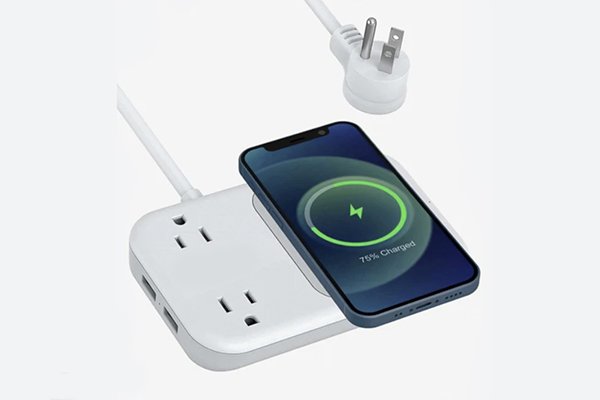
I used to think a power strip was just sockets, a switch, and maybe a couple of USB ports. Now I’m watching a new category take shape: power strips with built-in wireless charging pads. Fewer cables, tidier desks, and simple “drop to charge” habits—what’s not to like? Here’s what’s under the hood, where the market is heading, and what still needs work.
How Wireless Charging Power Strips Work: Technology Behind the Innovation
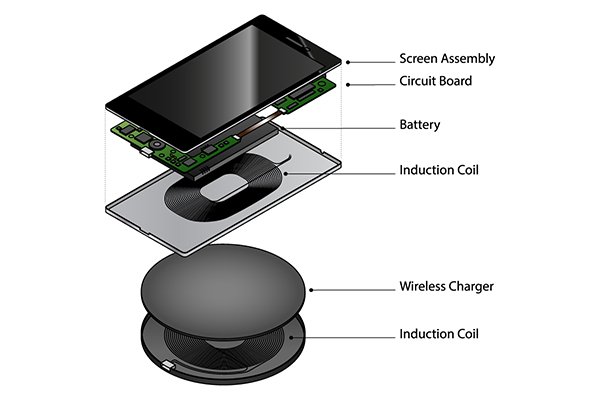
Wireless charging in strips typically uses inductive charging1 based on the Qi / Qi22 standard:
- Coils & coupling: A transmitter coil in the strip creates an oscillating magnetic field; your phone’s receiver coil converts it back to electricity.
- Drive electronics: A power stage (often GaN3) generates the high-frequency field, while a controller handles handshake, power negotiation, and safety.
- Alignment aids:
- Qi (inductive): fixed sweet spot; some strips use multi-coil arrays4 to widen it.
- Qi2 (magnetic): MagSafe-style magnets centre the phone for better efficiency and consistent 15 W delivery (device-dependent).
- Safety layers: Foreign Object Detection (FOD)5 to pause if metal keys or coins heat up, over-temperature sensors, and over-voltage/over-current protection.
- Power mix: The same strip may also include USB-C PD6 (30–100 W) and standard AC outlets—one bar that handles laptop + phone + accessories.
Real-world power: Qi pads are commonly 5/7.5/10/15 W. Cabled USB-C PD6 is still faster for laptops and big top-ups.
Benefits of Wireless Charging Power Strips for Homes and Offices

Why I find them compelling:
- Cable declutter: One bar replaces a nest of phone chargers; guests and colleagues can just drop and go.
- Habit-friendly: You place the phone down anyway—now it charges, no ports to wear out and no fumbling with cables.
- Shared spaces win: Hot-desks, meeting rooms, hotel desks, lounges—people instantly understand how to use them.
- Healthier batteries (used wisely): Slow-to-moderate wireless charge during the day keeps phones topped without frequent high-current bursts.
- Safer, neater setups: Fewer third-party bricks dangling from sockets; integrated overload, surge, and thermal protections in one CE/UKCA7 or UL/ETL-compliant unit.
Good use cases
- Home offices and bedside tables
- Reception counters / coworking benches
- Conference rooms (a couple of pads per table, plus USB-C PD6 for laptops)
Market Trends: Growing Demand for Wireless Power Solutions
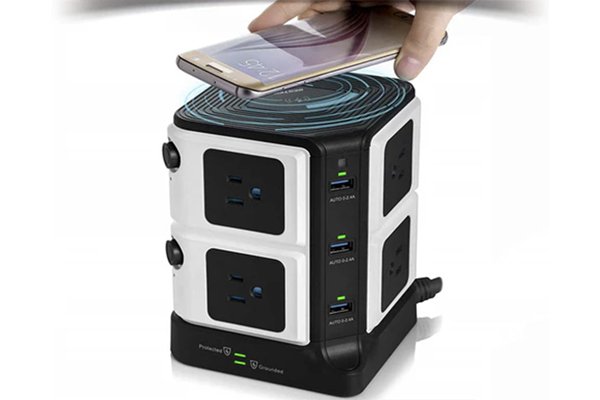
I’m seeing four clear shifts:
-
Qi2 goes mainstream
Magnetic alignment reduces mis-placement and raises effective power. Expect more Qi2-certified8 strips and stands baked into desk bars. -
Hybrid designs rule
Best-sellers pair Qi/Qi2 pads + USB-C PD6 (65–100 W shared) + wide-spaced AC sockets. One product fits most desks. -
Design for furniture
Slim housings, under-desk mounts, and top-surface charging “islands” are becoming standard. Hospitality and office furniture OEMs are integrating these modules from the factory. -
Eco & compliance pressure
Retailers ask for CE/UKCA7 (EU/UK) or UL/ETL (US), RoHS9 materials, recyclable packaging, and clear labelling (wattage, thermal limits, and FOD).
Challenges and Future Outlook of Wireless Charging Power Strips
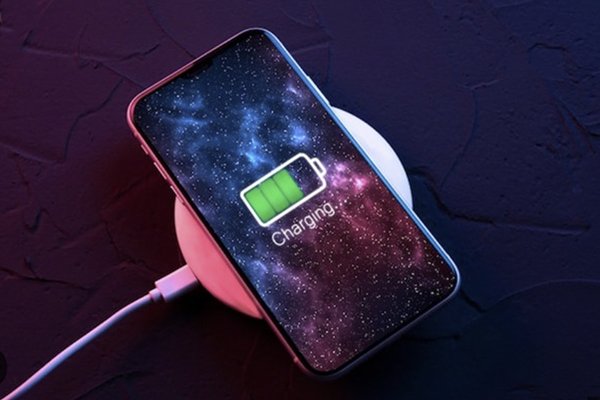
Where the friction is today
- Speed vs. cables: Wireless is still slower and less efficient than USB-C PD6. For big, fast top-ups, cables win.
- Heat management: Misalignment and cases can raise temperature; good designs add NTC/NTC-mapped throttling and proper ventilation.
- Standby draw: Multi-coil pads can sip power when idle. Look for strips advertising <0.5 W standby with smart sleep10.
- Multi-device interference: Two phones on adjacent pads need careful coil layout and firmware to avoid cross-talk.
- Certification maze: Beyond electrical safety (CE/UKCA7 or UL/ETL) and EMC (FCC/RED), Qi certification from the Wireless Power Consortium helps ensure interoperability.
What I expect next
- Wider Qi2 adoption, including magnetic rings built into more Android phones—making alignment easy and losses lower.
- Smarter power orchestration: Strips that juggle USB-C PD6 + Qi2 dynamically, prioritising whichever device needs power most.
- Thermal-first design: Better heat paths, graphite sheets, and predictive throttling to keep surfaces comfortable.
- Furniture-grade modules: Standardised, swappable charging “tiles” for desks and hotel nightstands, simplifying maintenance.
Buyer’s Quick Checklist
| Area | What to look for |
|---|---|
| Safety & compliance | CE/UKCA7 (EU/UK) or UL/ETL (US), FCC/RED for RF, RoHS9 materials, documented FOD & thermal cut-off |
| Wireless spec | Qi or Qi2 with listed wattage (e.g., 15 W), magnetic alignment if you use cases |
| Power mix | At least 1–2 USB-C PD6 ports (65–100 W shared) + wide-spaced AC outlets |
| Standby & heat | Idle draw <0.5 W, visible thermal safeguards, ventilation slots |
| Usability | Non-slip pad surface, case-friendly design, clear status LEDs, under-desk mounts |
| Labelling & docs | Clear per-port power map, multilingual manual, QR link to certificates |
Conclusion
Are wireless charging power strips the next big thing? For tidy desks, shared spaces, and casual top-ups—absolutely. They won’t replace USB-C PD6 for fast laptop charging, but paired together they make a brilliant, clutter-free setup. If you pick Qi/Qi2-certified8, safety-compliant models with low standby and good thermal design, you’ll get the best of both worlds: drop-to-charge convenience and serious power when you need it.
-
Understanding inductive charging can help you appreciate the technology behind wireless charging power strips. ↩
-
Learn about Qi and Qi2 standards to understand compatibility and efficiency in wireless charging. ↩
-
Discover how GaN technology enhances the performance of wireless charging devices. ↩
-
Learn how multi-coil arrays improve the efficiency of wireless charging pads. ↩
-
Explore how FOD technology ensures safety in wireless charging systems. ↩
-
Understanding USB-C PD will help you compare its efficiency with wireless charging. ↩ ↩ ↩ ↩ ↩ ↩ ↩ ↩
-
Understanding CE and UKCA certifications can help you choose safe and compliant products. ↩ ↩ ↩ ↩
-
Find out why Qi2 certification is important for ensuring reliable wireless charging. ↩ ↩
-
Explore RoHS compliance to understand the environmental standards for electronic devices. ↩ ↩
-
Understanding smart sleep can help you choose energy-efficient wireless charging solutions. ↩